




Pros & Cons of Cloud-Based Physical Key Management Systems
Explore the pros and cons of cloud-based vs. on-premises physical key management systems to determine the best fit for your organization.
7 min read

For facility managers, security teams, IT administrators, or anyone handling physical keys, even minor oversights can quickly lead to significant problems.
Automating key management with an electronic key cabinet is an excellent solution, which is why numerous options are available on the market. And many of them now boast about their always-ready systems managed with Software as a Service (SaaS) admin portals.
And SaaS means it’s in the cloud, right? Real-time data, always updated, always backed up. That’s why the provider is charging you a subscription fee, right?
That’s not always the case.
By definition, SaaS runs in the cloud. The value of cloud computing is your ability to purchase temporary access to a small slice of powerful IT resources, more than any company could hope to run on its own, unless its name is Google, Microsoft, or Amazon. You pay for that access with a subscription fee, which is what makes SaaS a service.
However, some providers will say their systems run on Software as a Service and charge a subscription fee, even though the software is just running on one of your own standard servers. They’re calling it SaaS because they claim to offer ongoing benefits, but it’s really just legacy on-premises software at an extra cost. It’s fake SaaS.
A common argument for sticking with traditional on-premises software for key systems is that it allows for greater customization, enabling software to be tailored to an organization’s processes. Also, it can be more secure. But today, more often than not, these beliefs are a costly distraction.
Every time you or your provider writes custom code to extend your key system’s functionality, you introduce more complexity into the application, which means more opportunities for the software to break in the future. If you’re managing sensitive keys, any gap in security, logging, or authentication can be a critical issue. And once you introduce custom code, you’re no longer just using software; you’re maintaining it.
Instead, you can go the more modern route and employ software as a service. True SaaS solutions sidestep the problem of customization and typically offer more options to configure your platform as you need. They’re running on very robust, redundant cloud infrastructure, so there’s little that can break, for example, by logging transactions in a way that meets your organization’s needs without requiring custom coding.
The way key management software is deployed and maintained, as a cloud-based service, on-premises, or as a standalone offline system, can have a major impact on both the time-to-value and long-term operational efficiency of your key control program.
On-premises software installations can require significant time beyond the physical installation of your key cabinets. Your IT team needs to provision a server, install the software, and configure it for your network.
In contrast, the SaaS model shifts the infrastructure burden to a cloud provider. You don’t need to buy hardware or manage deployment; you simply subscribe and start using the software. It’s plug-and-play. And time-to-deployment is short, so it’s easy to scale across locations or teams.
On-premises deployments require more upfront spending: hardware, licensing, and integrations all add up before the system even goes live. Then there are the ongoing costs of maintenance, upgrades, and support, all of which can be difficult to forecast and control.
On the flip side, SaaS software follows a subscription model, making budgeting significantly easier. Costs are predictable and evenly spread over time. Updates and maintenance are also included in the pricing.
In some situations, on-premises software allows for more customization, which can be beneficial for specific organizations. But customization introduces a greater maintenance and update burden. So you’re getting near-term flexibility, but at the cost of longer-term effort and risk. You’re also on your own update schedule, so any delays in patching leave you with outdated security.
With SaaS key management software, your provider and the cloud host manage all the updates, and they’re instantaneous. If a surprise security issue is discovered, it can be addressed on the spot—no waiting for “patch Tuesday” or another scheduled date.
This goes for both security and new features. If your key system provider is rolling out a new software tool for you, it can just appear instantly as soon as it’s ready, without any downtime for the server to update.
On-premises solutions typically require some of the support burden to fall on the customer, including patching, updates, and troubleshooting. Because the key management software is running on your own infrastructure, the provider typically needs local issues ruled out before they intervene to diagnose an application issue.
With SaaS cloud applications, everything is on the provider’s end. They handle everything by design. And because it’s a unified environment, it’s actually easier for the provider to manage; there’s no back-and-forth figuring out whose responsibility a problem is. So from a support perspective, SaaS is a win-win for everyone.
The cloud is also an excellent platform for disaster recovery, because you’re tapping into not only a larger pool of computing resources but also storage. SaaS providers can easily create copies of your key management records that you can restore at a moment’s notice. On-premises backups can be costly, which is why more and more on-prem IT managers are using the cloud for backups as well.
And yet again, SaaS in the cloud is just more natively scalable than on-premises infrastructure. You can purchase expandable on-premises hardware, but when it's time to upgrade, you’ll need significant downtime. Remember, with SaaS in the cloud, you’re buying a slice of a much larger infrastructure pool. If you need to scale up or down, it’s simply a matter of your provider adjusting a few backend settings.
On-premises key management systems often operate only locally or require a complex VPN setup, making remote access either difficult or impossible. Supporting multiple locations might work, but it will be cumbersome. Cloud-native SaaS key management software is designed to be accessible from anywhere. So administrators and users can access the system, update user permissions, request key reservations, or update sign-out logs at any time, from anywhere.
On-premises key management systems may offer greater flexibility in reporting, as you can customize the software more. But that flexibility often comes at a cost. Building and maintaining custom reporting typically requires developer time, either your own, a contractor’s, or the provider’s. That comes at a high cost.
SaaS platforms take a different approach. Analytics are built directly into the service, with dashboards, real-time reporting, and configurable alerts available right out of the box. Most can be tailored to your specific needs without coding, so you get actionable insights faster without requiring significant additional resources.
| Feature | SaaS | On-Premises “Fake SaaS” |
| Infrastructure & Installation | Pre-existing with the cloud provider, available almost instantaneously | Managed by you, requires staffing, project planning, and hardware |
| Cost | Known, fixed subscription levels | High upfront infrastructure costs and ongoing maintenance costs are less predictable over time as needs change |
| Updates | Automatic and managed by the key system provider | Customer’s responsibility, and often requires scheduling downtime |
| Support & Security | Also provided by the vendor, maintenance and compliance responsibilities, such as ISO27001 requirements, are included | Usually, the customer’s internal IT team is responsible for all maintenance, recovery, and compliance, based on the hardware they have deployed |
| Backup & Disaster Recovery | Easily available in the cloud, rapid recovery | Requires independent backup solutions and disaster recovery planning, often end up using the cloud anyway due to costs |
| Scalability | Cloud infrastructure for SaaS is highly scalable by design and near-instantaneous | Requires hardware purchases and planned upgrades |
| Accessibility | Accessible anywhere via secure login | Restricted to on-premises users or through additional remote access tools |
| Analytics | Built directly into the platform | Customization is dependent on developer time |
So that’s how SaaS and on-premises key management software stack up in key areas. When you understand how the cloud works, many benefits of using SaaS become obvious. But if you dig just a little deeper, you can find some pretty important hidden benefits. Or to put it another way, when the cloud is an option, there are some notable hidden costs associated with sticking with on-premises key management software.
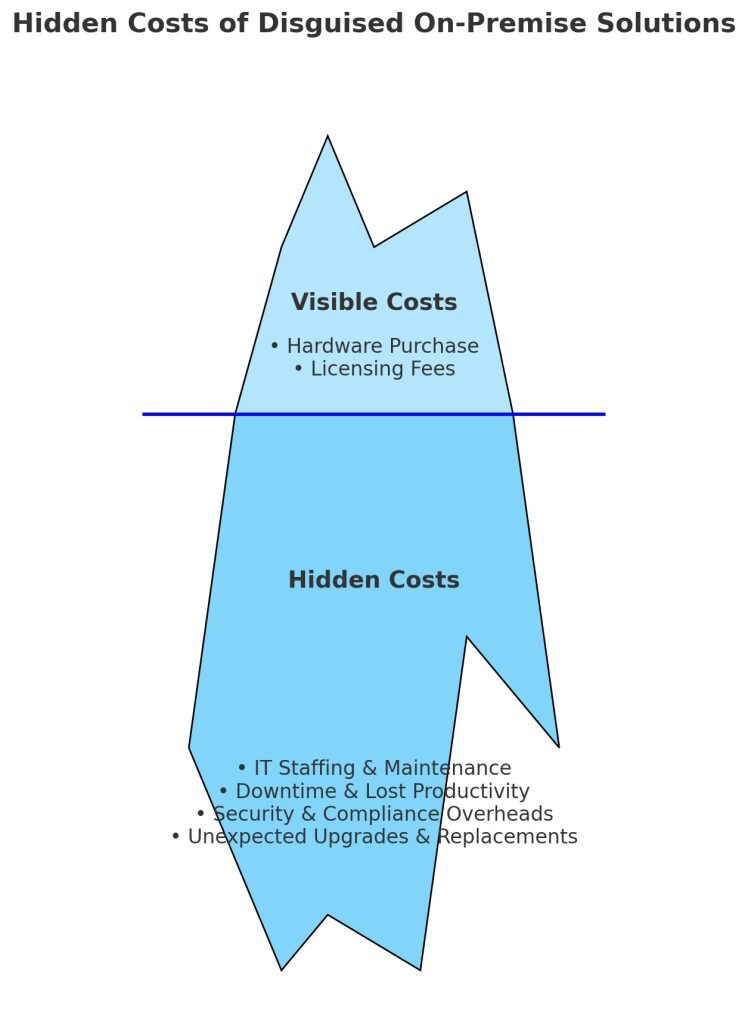
Most organizations underestimate the long-term cost of maintaining outdated systems, especially when factoring in:
What starts as a controlled investment in on-premises key software often balloons into a costly, ongoing drain. Before committing to any solution, ask: Are you buying software, or signing up for a full-time job maintaining it?
When you’re using on-premises key management software, updates typically require extensive planning, testing, and implementation, and all while your security and IT teams are expected to maintain day-to-day operations. Upgrading licenses can be costly, too, that is, if your existing hardware still supports them. Your key system provider updating on-prem software might require additional infrastructure upgrades, which would be your responsibility as well.
You’re sinking a lot of resources into what are sometimes very marginal gains. You’re trapped in a cycle of low performance gains.
So, ask yourself: how much is it worth to shift the burden of SaaS key management to a provider, allowing your staff to focus on their core mission? The answer is often significantly less than SaaS subscriptions.
Without built-in automation for reporting, scheduling, and transactions, you risk your staff becoming mere human extensions of the software, doing work that should’ve been automated in the first place with an electronic key system.
Similar to the upgrade trap, this situation diverts skilled workers away from more essential tasks to perform routine work. And work that is unfortunately too easy to ruin with small human errors. You’ll incur higher risk, reduced productivity, and frustrated staff.
Slow upgrade cycles mean slow adaptation. In today’s market, where speed and agility are often your greatest competitive advantage, waiting months or years for new features can leave organizations at risk of falling behind shifting regulations and evolving security threats.
This isn’t just about software, it’s about organizational responsiveness.
When it comes to key management, the technology you choose isn’t just for tracking physical assets. It’s about making your organization more efficient and secure. A SaaS-based key management system is a modern infrastructure that provides significant value, including scalability, responsiveness, reliability, and adaptability. And all without the burden of constant maintenance or costly upgrades.
By partnering with a provider like ecos systems that fully embraces the cloud, you're unlocking:
In a world where outdated key management systems masquerade as cloud solutions, choosing a provider that utilizes genuine SaaS software is one of the clearest ways to future-proof your operations and avoid getting stuck in the upgrade cycle.

Explore the pros and cons of cloud-based vs. on-premises physical key management systems to determine the best fit for your organization.
.png)
Key management systems secure physical keys, cut costs, and optimize operations for businesses of all sizes. Get the steps to implement one...

Discover the hidden costs of physical key management and learn how cloud-based systems can save your business time & money and enhance security and...