





1 min read
For years, RFID has been the go-to standard for tracking high-value equipment. But in workplaces where speed, accuracy, and reliability matter most, new precision management tools are beginning to replace it.
Interference from metals and building materials, weak signals, and the cost and complexity of tagging every item can burden business operations. That’s why a new approach is emerging, one that doesn’t rely on tags or signals, but instead leverages the readings of precision digital scales to track which items are taken from storage, what’s missing, and when contents change in real time.
This isn’t just a small, iterative improvement in equipment management. Adding weight recognition to smart equipment management systems can fundamentally shift how organizations manage their tools, weapons, and consumables.
In this article, we’ll explore how weight-based tracking overcomes the limitations of RFID, reduces the implementation costs of new smart management systems by up to 60%, and delivers unmatched accuracy under real-world conditions.
Quick RFID Overview
Radio-Frequency Identification (RFID) systems do offer value. That’s why ecos systems offers RFID tracking options in all of its locker systems.
They help automate equipment check-ins and check-outs, reducing manual labor and improving your insight into asset use. Over time, this data can help organizations optimize inventory levels and streamline operations.
RFID relies on small tags that communicate with readers when they’re nearby. It is widely used across industries for asset tracking and other automated, short-range recognition tasks. However, despite its strengths, RFID has important limitations, especially in verifying what is actually inside smart lockers.
Before exploring the compelling advantages of weight recognition, let’s first understand the current standard technology. There are three main types of RFID transmission: Active, Passive, and Semi-Passive. Each has distinct capabilities and use cases.
Active RFID
Active RFID tags are small, battery-powered devices that function as antennas. They continuously broadcast their ID over long distances. They have a typical maximum range of 100 meters.
They’re best used to track high-value assets in real-time. For example, they’re often used to track automobiles moving through an assembly plant as they’re built. However, the size, cost, and limited battery life of active tags make them less practical for smaller or frequently rotated items.
Passive RFID
Passive RFID tags contain no internal power source. Instead, they draw a wireless charge from the RFID reader when they’re nearby. The outgoing radio wave from the reader “powers up” the tag, and the tag bounces back its ID and any other relevant stored information.
Passive tags are small, inexpensive, and ideal for short-range use cases. However, because they rely on proximity, they are most effective in controlled environments where line-of-sight scanning is possible. Metal surfaces and building materials can easily interfere with these low-power signals.
Semi-Passive RFID
This is also called semi-active RFID. Really, it’s just a mode that balances the benefits of active and passive RFID. Semi-passive tags utilize a small battery to power their internal circuits, but they still rely on the reader for communication. They offer improved read accuracy and added features like temperature or humidity sensing, but, like passive tags, they require proximity to transmit reliably.
Limitations of RFID Tracking
In real-world use cases, RFID introduces several operational and security challenges.
Limited Insight into Usage
RFID tracks presence, but not behavior. You may know when a device was checked out and returned, but not how it was used or whether it was tampered with during that time. That lack of visibility limits your ability to spot errors or malicious misuse.
Signal Interference
For RFID tracking to work, there needs to be a clear signal between tags and readers. But in environments with metal cabinets, concrete walls, or electromagnetic interference from other wireless devices, signals can be weakened or blocked entirely. This can lead to inconsistent tracking, so it’s not always a viable choice in every business environment.
Tag Vulnerability
RFID tags are small, which is one of their selling points. But that also makes them fragile. They can be easily damaged, fall off items, or become unreadable over time due to wear and tear. When this happens, your tracking system won’t recognize the tag or even realize it's present.
Scalability Challenges
As your equipment management program grows, so does the complexity of managing RFID infrastructure. More assets mean more tags, more frequent audits, and potentially more readers or middleware to support reliable communication. What starts as a simple tracking solution quickly becomes a logistical nightmare.
Security Risks
Because RFID systems rely on wireless communication, they’re vulnerable to cloning or spoofing attacks. A determined attacker with the right tools can sometimes mimic a tag’s signal, gaining unauthorized access without triggering alarms. In high-security environments, this represents a serious risk that traditional RFID alone can’t prevent.
Why Weight Recognition Outperforms RFID
Weight recognition doesn’t suffer from those performance issues.
Seeing What RFID Misses
Unlike RFID, which relies on line-of-sight communication between tags and readers, a weight-based tracking system simply detects presence by measuring weight when a user returns an item as they normally would. There is no signal to lose, no interference, and no risk of undetected removal, even when items are nested inside a toolkit. Detecting weight variance down to 1g makes removing even one or two screws from a toolbox noticeable.
Detecting Consumable Use
One of the biggest shortcomings of RFID is its inability to track partial use of consumables, like ammunition. A tagged magazine may be accounted for, but if rounds have been removed, RFID alone won’t flag the discrepancy. You’re dependent on manual reporting. That creates serious risks in settings where ammunition or other consumables require tight control.
ecos smart lockers can identify even small weight changes, so you’re not reliant on your personnel to accurately record material use.
Real-World Reliability
Equipment tracking should be seamless and reliable. Manual scanning or tag-based systems introduce extra steps. If you’re relying on RFID, as we’ve seen, you may not be collecting reliable data.
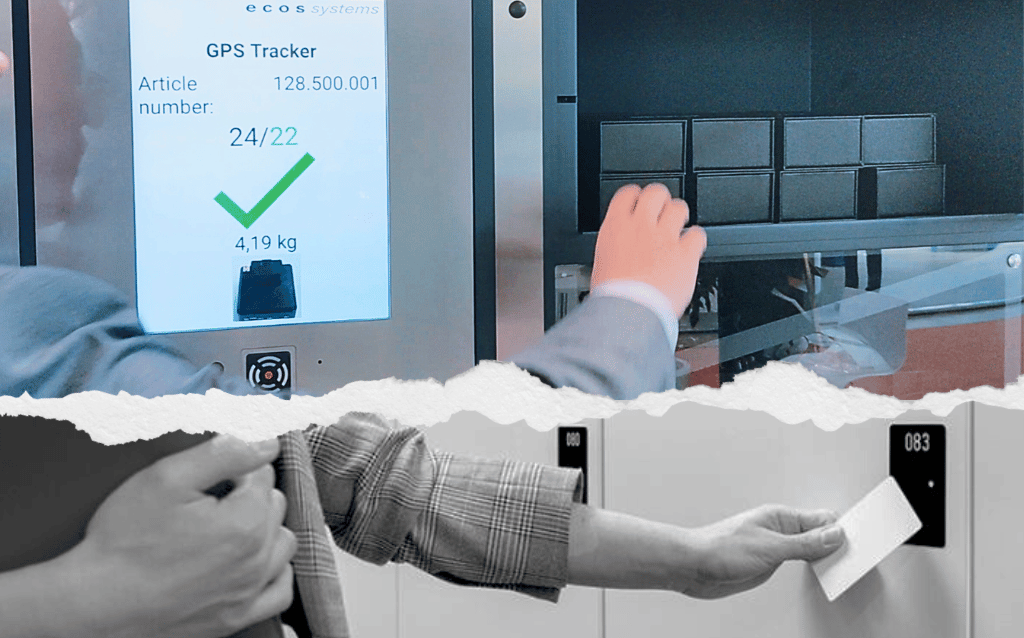
With some systems, it may be necessary to scan items in and out, like with TapID. But with precision weight recognition, there's no scanning of the item. The simple act of taking it out of the compartment or putting it back in is recorded by the sensor in the locker, and the information is logged as the object being present or absent.
For example, in a police armory, officers often need to retrieve duty weapons and equipment quickly before heading into the field. A weight-based locker instantly records when a firearm is taken, even if they need to rush into the field.
Faster Access, Zero Scanning
In other asset locker systems, users often have to pause to scan items in and out—a small step that adds up to meaningful time across dozens of transactions a day. And in urgent situations, this delay can be unacceptable.
Weight-based tracking in ecos systems works silently in the background. Officers, technicians, or staff retrieve or return equipment as they normally would. The system detects the change instantly and records the transaction without requiring any additional action.
ecos RFID solutions also don’t require tap identification. Like weight tracking, you simply need to place the tagged item back in a compartment, and the system will read it.
No More Mid-Shift Inventory Checks
Traditional locker systems rely on scheduled scans or manual audits to reconcile discrepancies, which often require personnel to be pulled away from their essential duties. RFID tracking can help, but as we’ve already highlighted, it doesn’t necessarily confirm an item’s presence or whether it’s been tampered with, or a consumable’s level.
Because weight recognition continuously monitors inventory in real time, there’s no need for routine scans or end-of-shift reconciliations. What you see in the system is always what you have in the locker.
Towards a Simpler, Smarter Approach to Equipment Management
When using an RFID-based equipment-tracking system, you need to tag every item you want to track. Unfortunately, that creates a significant failure point. Any issue with a tag makes that asset untrackable. And every asset entering your organization requires a new tag.
What if you could eliminate tagging entirely and still track everything with precision?
Unlike RFID systems, which require individual tags, programming, and maintenance, precision digital scales can be embedded in smart lockers to detect the presence or absence of equipment.
ecos systems lockers, for example, can have scales in drawers or compartments. They can detect when items weighing anywhere from 1g (⅓ oz) to 100kg (220 lbs) are taken or returned, simply by tracking weight changes in fine detail.
So, for example, if you’re managing firearms in law enforcement or for a corporate security team, you likely are required to track when weapons are discharged. ecos smart lockers can determine instantly if a single round has been expended when ammunition is returned to the locker. The same goes for pepper spray canisters. The system can compare pre- and post-weights to determine whether an officer used the canister.
In high-security environments or for particularly sensitive items, you can even combine RFID and weight tracking for enhanced security. RFID enables you to confirm the presence of a specific object, and precision scales add an extra layer of validation and the ability to track consumables.
This fundamentally changes how organizations set up and manage equipment, primarily through:
Faster ImplementationRFID deployments can often take weeks or months to complete. Every item must be tagged, entered into the system, and tested. And tags must be placed in very specific ways on equipment, especially if that equipment is part of a kit, for the system to read them correctly. Even then, when tags inevitably go missing or get damaged, it means more hours of work.
Weight-based tracking eliminates that complexity. There’s no need to tag items individually. Simply place them in the locker, and the system automatically recognizes their weight signature. Setup time drops dramatically, allowing teams to go live faster with fewer steps, fewer errors, and far less administrative overhead.
Lower CostsThe financial impact of switching to weight tracking is just as significant.
Removing RFID tags, readers, and related middleware from a smart locker deployment can reduce implementation costs by up to 60% compared to RFID solutions. It’s a leaner approach to equipment tracking, providing full visibility into equipment utilization without the need for additional infrastructure.
The Future of Equipment Management Is Smarter And Simpler
At ecos systems, we’ve built smart lockers that don’t just store equipment; they understand it. To that end, weight recognition isn’t just an alternative to RFID; it’s a step forward in how organizations track, manage, and maintain critical tools and consumables.
If you're ready to move beyond the limitations of legacy tracking methods, it’s time to see what weight-based intelligence can do for your organization.

1 min read
Critical Infrastructure Security Begins With Asset Accountability
Shannon Arnold : 1/26/26, 12:15 PM
You might have bleeding-edge cybersecurity ready to pounce on any threat coming over the Internet, but that means nothing if attackers can just gain...

1 min read
The Hidden Cost of Warehouse Technology
Shannon Arnold : 9/4/26, 3:03 PM
Why Your Scanners, Headsets, and Smart Glasses Keep Disappearing Most warehouses that don’t have enough devices to go around aren’t actually...